Tuesday, March 27, 2012

Day 34

I have to share my breakfast - inspired by the food from Farm and Table. It was so successful I had it almost every morning this week. As most everyone knows, I'm working for an new restaurant in town that is not only amazing and exciting in lots of different ways, but also falls really perfectly in line with what I'm doing with this project. Also, our food is pretty undeniably amazing.

One of the items of the brunch menu is a traditional New Mexican staple, which, shamefully, I had never heard of before, called atole. Atole is a kind of cornmeal porridge made from toasted masa and here in New Mexico, it's made specifically from blue corn masa. When I tried it for the first time at Farm & Table, it was (unsurprisingly) amazing, so when I saw a bin of atole flour at the co-op while cruising for new, rules-happy meal, how could I not take some to try?

Finding a recipe online was a little difficult, since it turns out that New Mexican atole is different from traditional atole, but when I finally found one that looked right, I was surprised and skeptical about how quick and simple was supposed to be. It's basically just flour and water:

Ingredients
1 cup blue corn meal
2 cups milk
2 cups water
Sugar to taste
1/2 tsp salt

Directions
Mix blue corn meal, salt and water and bring to boil, stirring constantly. Add milk and stir until thickened. Serve hot and add sugar to taste.

See? And it actually was that easy. AND it only took about 5 minutes, AND it made enough to last the entire week.

Now, I know what amounts to a bowl of flour isn't exactly the best way to start a morning, and as a result this sadly won't turn into an every day thing, but atole is a very traditional food and thus, in my opinion, falls into the category of Rule 48 (Eat more like the French. Or the Japanese. Or the Italians. Or the Greeks), and thus, in my opinion, gets the thumbs up. Or maybe I'm just trying to justify continuing to make this delicious food.

Because, most importantly, it tasted great.


I added a little maple syrup, some walnuts and some strawberries, but the possibilities of how to dress it up are endless. My friend Monica used to add cinnamon sticks and cardemom pods to the water she boiled our oatmeal in - I'm wondering how that would taste with atole. I bet it's amazing.

I'm not sure how readily available blue corn atole flour is outside New Mexico, so this might be just a completely worthless post if you're located outside of the Land of Enchantment. But I think I've seen this brand sold all the way out in New York, so don't lose hope! It's definitely worth looking into.

Saturday, March 24, 2012

Day 31

25. Eat mostly plants, especially leaves.

Speaking of plants my Harvest Baskets from Skarsgard Farms have starting coming and Oh. Em. Gee. They are the best thing in the entire world. It's like every Tuesday, Santa just brings me a gift of fresh fruits and vegetables and leaves it on the front door. It is SO exciting; I get giddy on Tuesday mornings when I realize they're coming today.

The first week in the CSA, I put a cabbage in my harvest box, partly because my cousin Claire has a delcious and simple recipe for coleslaw (cabbage, carrots, vinegar, salt) but mostly on a whim, because I really have no idea what to do with a head of cabbage.

Later in the week, because of my own self-imposed, possibly-excessive rule to only eat bread that I have baked myself, I found myself in a frustrating bit of a bind. I had delicious mayo that I had taken the time to make over the weekend. I had delicious tomatoes from Skarsgard Farms. I had amazing sliced deli meat that I had taken aaaaalll afternoon to go up to Keller's, the fancy meat shop with a wide selection of local/small-farm products. The only thing I didn't have was bread.

And I really wanted a sandwich. Plus (surprise, surprise) I was running late, and I just wanted something I could grab and eat with me on the run.

So, long story short, I decided to make lettuce wraps instead, and use the leaves from my cabbage. Truthfully? I thought this was going to be a total disaster. Oh God, I kept thinking to myself, this is going to be a sad, sad lunch. I thought the cabbage would taste weird and overpoweringly cabbage-y, the inside would be bland, and the whole thing would be a wet, sloppy, slimey affair, as all my experiments with lettuce wraps have been in the past.

A ham sandwich, wrapped in cabbage leaves


I was. So. Wrong. These lettuce wraps were amazing, and held together like magic. Cabbage leaves! Who knew! I went through a phase in college when I was obsessed with the South Beach diet (don't judge), a time during which I tried my hand at a lot of lettuce wraps and they were always limp and pathetic excuses for meals. Apparently, sturdy cabbage leaves were all I needed.

Inside, I threw some homemade mayo, some dill weed, smoked ham, tomatoes, avocado and shredded carrots. The shredded carrots were another bonus: as a part of my mission to eat plants, as Pollan instructs, I make sure to take time during the preparation of every meal to think, "Is there some way for me to add just one more vegetable to this plate? The carrots were my extra vegetable here - not something I'd usually put in a sandwich, but with the lettuce wrap, it seemed like it made sense - and it did. The carrots were a subtle, crisp, fresh addition to the wrap.

But I think the mayonnaise is what made it stand out, although when I told Farm & Table's head chef about the mayonnaise in my creation, he gave me a look of total confusion and possibly even personal offense that I would do something so unpleasant with my food. So what do I know? All I know is that I made a lettuce wrap and I thought it was going to be awful, but it was fantastic instead.

A more artful cook would have found an attractive and/or edible way to keep them rolled shut... me, I used rubber bands.


In fact, now that I know how sturdy and how mild cabbage leaves are, I'm ready to stuff all kinds of stuff inside there. A turkey caprese cabbage roll, for example, with smoked turkey, fresh mozzarella, tomatoes, basil and balsamic vinaigrette. Or a chicken fajita cabbage roll, with peppers, onions, and grilled chicken.

Needless to say, I sort of felt like I had won the jackpot. Not only did I find a healthy, flavorful, filling alternative to a sandwich, swapping the bread for cabbage makes me feel like I've taken a HUGE step closer towards eating mostly plants.

Which is a big deal to me. I make it a point to eat vegetables and fruit with every meal, and since starting this project, I always dig into the vegetables first. Still, Pollan doesn't just say "eat plants," or even, "eat plants with every meal." He says, eat MOSTLY plants. I have to admit, despite my best efforts, I still think of vegetables as a side - there aren't a whole lot of plates that utilize veggies as the main dish that I would feel totally satisfied eating. But by adding cabbage and carrots to a fairly common lunch of mine, I can add at least one to the list. And it's important, despite my shortcomings, to keep striving.

Mostly plants, Leigh. MOSTLY PLANTS.

Thursday, March 22, 2012

Day 29

24. When you eat real food, you don't need rules.

I mentioned this rule briefly yesterday, but I actually have a lot of thoughts on this particular rule.

A consummate dieter since my body-loathing pre-adolescence, I'm sort of mesmerized with the idea of a rules-free existence. As early as thirteen years old, I can remember cruising the mall, watching my friends buy junk food in the food court thinking pathetically, "Nooooo!!! I'm not supposed to be eating that!"

Oh, if only I had known then that that would be the framework for the entire rest of my life. From there, I proceeded down the dark and complicated maze that is endlessly retaining and catologuing nutritional do's and don't's: your body processes refined carbs like a spoonful of sugar. Three ounces of cheese has how many calories? Easy on the sugar, easy on the fat. Unless it's healthy fat, like olive oil and avocados? No, wait, easy on those too - they may make your heart healthy, but they still make your hips wide.

I don't mean to say I was ever a crazy, crash-dieter. I pretty much stayed away from the fads or anything sounding to weird or radical. I wasn't ever looking for a quick fix, but at the same time, I didn't look the way I wanted to look and I knew I had to make a real, serious effort for that to ever change.

So, for over a decade, I'd try out new and unpleasant restrictions - this time counting calories, this time cutting back on carbs - only to get frustrated and give up. Or I'd lose a few pounds and plateau, and then get frustrated and give up. Eventually, I lost a LOT of weight, and then got frustrated and gave up. And then gained a little of it back, and got scared, and came to accept that the constant monitoring and math, the calorie-counting and the polite, "no thank you's," would simply always be a way of life for me.

But I don't like it. It makes me truly sad to think of all the times I've demurely sipped on soda water and lemon at the bar whilst the crowd around me ordered tequila shots and cheese-fries. So as much as anything else, this project is an experiment for me. Is it possible to live a life free of incessant rules about food? Ironically, despite the fact that the project is about FOOD RULES, I've been enjoying an exhilerating amount of freedom. No constant questions about every little thing I put in my mouth: Is this too many calories? Is this a good ratio of protein to carbs? How much cheese have I eaten today? None of that.

If this works - if this is a way to escape that cycle of constant counting and second-guessing that I've known since before I was a teenager - then these rules are worth it just for that.

The question, then, is how is it working? Well, it depends on how you measure it. I feel pretty good - alert, aware, and, given the fact that I'm working roughly 50 hours a week (and that's just what I'm paid for), not too tired.

On the other hand, I'm pretty sure I've gained weight. Which, in all honestly, is probably a sign that I'm "cheating," somehow. After reading this book cover to cover, I believe that if you do it right, there's no way you could gain weight, as the bulk of your diet should be nothing but fruits, vegetables, and whole grains.

I suspect that relying too heavily on Rule 24, my favorite rule, at the expense of less fun rules like 54 (Eat less) and 43 (Avoid sugary and starchy food if you're concerned about your weight). Those two have already been major parts of my endless battle with rules, and, in the spirit of Rule 24, I'd like to stop thinking about them constantly.

But at the same time, I know that in certain ways my diet has changed possibly for the worse; in the absence of meat, for example, in the majority of my meals, I've been beefing up (no pun intended) on my cheese intake. I did this a lot when I was a vegetarian and fat. It makes sense to me - cheese replaces much of the protein and the flavor that's gone when meat vacates the plate. But it also adds a lot of fat, and is probably not in the spirit of Pollan's rules. Also probably not in the spirit of the rules? Eating nothing but a salad and a big potato for lunch multiple days a week because you can't find anything else in your fridge that you can eat.

This was my lunch earlier this week. No joke.


What I'm trying to say here is, I'm torn. On one hand, I want to live in the spirit of the idea that if you think about what you eat and eat well then all that calorie-counting, carb-counting, fat-counting crap is not necessary. On the other, when I can feel myself gaining weight, it triggers a reflexive response to ammend the way I'm eating, and I'm honestly not sure if that's an appropriate response or not.

It's also worth noting that I might feel like I've gained weight because I'm eating all kindsa things I'm usually not "allowed." Or, I may have gained weight because I've been so busy with this project, I've hardly had a chance to work out in three weeks. I am, however, NOT stepping on a scale until the project is over, because if I confirm that I've gained weight, I won't be able to stop myself from changing my diet, and as worried as I am about the weight issue, that's not what this project is about, and I don't want it to take focus from what I'm really trying to do.

So until then, all I can do is continue to try and live the rules as honestly as possible, and hope I've done my best to uphold the spirit of all of them, even if some of them seem, at this point at least, to be quite contradictory.

Tuesday, March 20, 2012

Day 27

22. It’s not food if it arrived through the window of your car
23. It’s not food if it’s called by the same name in every language (think Big Mac, Cheetos or Pringles).


Does this mean I can't get coffee from the Starbucks drive-thru?

Actually, the answer to that question is moot, as I tend not to drive a car anyway. And even if I did, I restrict my fast food intake to three times a year, maximum. I try to make it only once or twice. And junk food like Pringles and Cheetos have been generally banished from my belly for many years now, so that's no big deal either.

I used to love fast food. Even when I was a vegetarian - I orded the Fillet O'Fish. Who cares? It all tastes like the same salt-and-grease-soaked cardboard anyway. Mmmmm, grease and salt.

Anyway, I don't really know what happened. One day, I just... stoppped craving fast food. I think a part is due to the documentary Super Size Me, which I never saw, but heard enough about the massive weight gain and cholesterol spike, mood swings, sexual problems and other various health issues Mr. Spurlock suffered after eating nothing but McDonald's for a month straight to get the basic idea.

Think about it this way. I told myself. McDonald's products not only fail to nourish, they actually actively harm you. It's not just not-food, it's worse: it's anti-food.

Anti-food, anti-food, I'd think to myself whenever I was tempted during days of wandering the streets of New York looking for a decent lunch to stop wasting time and money and just buy a damn Wendy's cheeseburger.

And after a while, fast food actually stopped looking like food.

If only ALL my vices could be solved so easily.

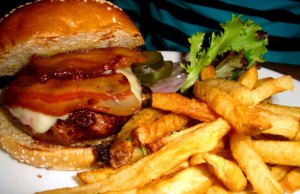
In fairness, my disinterested is also probably due it part to my post-vegetarian obsession with burgers. Y'all, I am REALLY REALLY SUPER PASSIONATE ABOUT BURGERS. Specifically bacon cheeseburgers. Cooked medium rare. Consumed with beer.

Mmmm. It's difficult to type right now, because my eyes are rolling back into my head just thinking about it.

But when you really, really love burgers, and you've had a really, really good burger, how can the slop they serve at Mickey D's possibly cut it?


A burger from Back Forty in New York - maybe the best burger I've ever had


Which, I believe, is an important point of this book. Appreciate your food. LOVE your food. Food is so quickly and cheaply available in this country that it's too easy to just eat without any real awareness of it. But when you take the time to truly love and appreciate your food, you will naturally choose good food, real food.

Which is, in fact, the next rule:

24. When you eat real food, you don't need rules

Monday, March 19, 2012

Day 26

19. Eat only foods that have been cooked by humans.
20. Don’t ingest foods made in places where everyone is required to wear a surgical cap.
21. If it came from a plant, eat it; if it was made in a plant, don’t.


These three tricksy rules, particularly number 21, have been the bane of my existence since this project began.

When you think about it, what isn't made in a plant? Other than your most basic produce, pretty much everything can fall under some definition of having been made in a plant. Let's just start with breakfast: the coffee I drink every morning is roasted in a plant; the bread I eat it with - even if I bake in with my very own hands, the flour was probably milled in a plant (and they probably wore surgical caps too). Breakfast cereal is automatically out (which would answer my previous question), but what if I made my own granola? Well, would I put oats in my granola? Where were they rolled? (Answer: probably a plant.)

And, I suppose, this is sort of Pollan's point. Fresh produce, whole grains. That's it. That's about all that doesn't come from a plant, and at the core of the matter, that is all we need to be eating. And if it's so difficult to strip the rest of it away, well, that's what these rules are for - to make us aware of what we eat versus what we really need.

Which is all well and good on a philosophical level, but I don't knw about you, but I need a little more than that to get along, even for six weeks. A little milkfat. A little animal protien. A little sugar. And it's worth noting that nowhere in this book does Pollan explicitly advocate vegan/macrobiotic diet - which is what an all-whole grain and produce diet would resemble - although he sure seems to suggest it implicitly in this and other rules.

The fact is, if you take this rule at its strictest word, you don't even need the other 82 rules, because you're already going to be churning your own butter, Amish-style.

Okay, so obviously, we need to loosen our interpretation of "made in a plant," to some degree.

My first impulse was to say, okay, if it's packaged in a plant, but is more or less the same thing it was when it went in, that's okay. Allowable under this rule would be things like rice and certain brands of canned beans.

But that still leaves out a lot of very necessary items - most notably flour. Because how am I supposed have bread if I can't buy it in the grocery store and can't use flour to make my own? I sure wasn't going to grind my own flour and, while I see the benefits of reducing one's intake of processed grains, I think giving up bread completely is - like veganism - extreme to the point that it loses sight of the purpose of Pollan's book. Which is simple. And not extreme. Eat food. Eat real food.

Yeah... I'm not doing that. (Image from bcliving)


Okay, so how about: foods that are basically one thing, and that one thing leaves the plant in a different form, but is still essentially just that one thing are also okay. Flour goes on this list, obviously. So does peanut butter, as long as it's just ground peanuts and maybe salt.

These were the rules that I had set and was prepared to follow until that fateful day that I opened up the refrigerator and realized I couldn't eat anything whatsoever. I'm not sure where things like cheese and yogurt fell on this spectrum, but to be safe, I had decided that I would either make them myself or buy them at the Farmer's Market.

Reminder: I have not yet made it to the Farmer's Market. So that should tell you a little of how well that idea went.

Honestly, I think I would have had to tinker with my interpretation of the rules anyway, because as they stood, they barred the consumption of soy sauce, a product Pollan specifically instructs me to eat (Rule 36) So... that can't be right.

Anyway, long story short, the rule that I eventually fell upon is sort of a bunch of the rules smooshed together and modified. If it follows ALL of the other rules, and it especially has less than 5 ingredients, and I can at least imagine a human being making it, then okay. Okay fine. It counts.

Oh, additionally, if it's reasonably possible it myself rather than buying it, then it's off the nice list and on to the naughty list. Unfortunately, "reasonably possible" is a subjective term which has frequently resulted in me thinking, I am running out the door and I NEED BREAKFAST. It is not reasonably possible for me to make yogurt! Yogurt from Trader Joe's is my breakfast! and then thinking later, making yogurt isn't THAT hard. I shouldn't have done that. And then subsequently becoming filled with feelings of guilt and failure.

Anyway, now that I see it written down, I can't really explain my math for why the sum of all these rules equals "not made in a plant," but... it still sort of makes sense on an intuitive level. I suppose I can allow myself to believe that while, say, Cinnamon Toast Crunch definitely made in a plant, things like yogurt or cheese or my corn tortillas that contain corn, lime juice and salt might be made in a facility equipped for mass-production (ie, a plant) but they're essentially being made the way human beings have made them for years and years, just on a much larger scale.

Yep. That's how I'm playing this. I don't feel good about it. Just, shhhh. Just go with it.

Wednesday, March 14, 2012

Day 21

So after I made my delicious loaf of bread, I tried to make my first sandwich in almost three weeks, and realized almost immediately that the mayonnaise in the fridge was off-limits. Which makes for, in my book at least, a pretty weak sandwich. And I wasn't going to tolerate that. I FINALLY made a loaf of bread. I was FINALLY going to get to make a sandwich. It was GOING to be a delicious sandwich. It was GOING to have mayo.

I found a recipe from my favorite Food Network personality and, because I trust Alton with my whole heart and soul, I dove right in.

And let me tell you, there was a lot of trust involved with this recipe. In further demonstration of my food ignorance, until last night I had never actually seen mayonnaise made before. And, while I knew that it was basically eggs and oil and vinegar, I never really thought about it until I saw the recipe. At which point I thought, Really? I'm just going to mix up some oil with an egg yolk and it's going to turn into mayonnaise and not just a big, greasy, liquidy mess? I was highly skeptical.

As per Alton's instructions, I whisked one egg yolk with 1/2 teaspoon fine salt, 1/2 teaspoon dry mustard, and 2 pinches sugar.

So far so good...


After that, you mix 2 teaspoons fresh squeezed lemon juice and 1 tablespoon white wine vinegar together in a separate measuring cup and then pour about half of it into the egg yolk mixture and whisk HARD until you get an emulsion.

Or, so I'm told. You're supposed to whisk until the mixture gets a little bit lighter and thicker, although I whisked for a good long time and didn't see much of a change. Eventually, I just thought, Well, hope that's good enough... and prayed I didn't totally screw it up.

And I didn't! To my complete surprise, as I dropped a few drops of oil into the mixture and continued to whisk hard, a mayonnaise-like substance actually began to form.

Whaaaat!?


So after the mixture starts looking like mayo, you can ease up a little and start pouring the oil in a thin, steady stream. Which is kind of a two-person job. If you don't have a second person, you can make it in the food processor, or, if you're like me and you don't have a second person and you don't realize until you're pretty much done that there was a much easier way to do this, I found that alternately adding the oil in small quantities and whisking worked just fine.

This was also the only place I differed with Alton. He says to use safflower or corn oil, but since I'm not sure if you can get either of those oils through stone-grinding (Rule 42) and I was too lazy to check, I went with olive oil. Olive oil will apparently make a darker mayonnaise with a distinct olive oil flavor, which, to me, is a total plus.

Anyway from there it's pretty easy - just slowly add half the oil, then the other half of the vinegar and lemon juice, then the other half of the oil (still slowly) and whisk until your arm falls off! Mayonnaise!

From start to finish, the whole project probably took about 20 minutes and, unlike ketchup, was not a pain in the ass at all. The recipe made enough mayo to last me longer than it will probably keep, which, according to Alton, is a week. Not gonna lie, I'll probably try and eat it for two. If I don't die, I'll report back with my findings.

The end result, by the way was fresh and delicious. I don't think I even knew what real mayo is supposed to taste like. I can tell already that it's going to blend with other ingredients like lemon and dill or roasted garlic way better than bottled mayo, which makes me nerdily excited. Aioli time!

Tuesday, March 13, 2012

Day 20

16. Go food shopping every week.
17. Buy your snacks at the farmers market.
18. Eat close to the earth.


While I can't shake the image of eating my dinner from a seat on the floor, Japanese-style, that's not actually what Michael Pollan means when he says Eat close to the earth. What he means is to try and eat your food as close as possible to the moment when the earth offers it up. Shorten the journey it takes to your plate; eliminate any and every step on that journey that you can.

The reasons for this rule are abundant, ranging from the practical (the shorter the journey, the less fossil fuels burned transporting it to you, and the less opportunities for unknown entities to fill your food with additives) to the more abstract (if your food comes from nearby, you're likely to be more knowledgable about it and thus make better choices) to the philosophical (the more connected you are to your food, the more connected you will be to yourself, your body, and the world around you.)

The ideal, of course, is to pick the apple straight off the tree, though most of us can't just go foraging for our food. Still, there are things we can do: we can buy as local as possible. We can shop at the farmer's market instead of the supermarket. We can make food for ourselves where we would have let others make it in the past.

For me, what this is has come down to is if there is a reasonably feasible way to shorten the distance to my plate, I have to take it. If there is a local option, I have to buy it and if there's a way to live without it when there's not a local option, I have to live without it.

And I can't buy bread. I know this sounds pretty arbitrary - bread, especially if its purchased from a bakery or farmer's market, is a pretty innocuous entity; not really a Food Rules offender in any other way - but stay with me. And here's the thing: baking bread is SO SIMPLE. I might not be able to make my own cheese, or raise my own chickens, but gosh darn it, I can make bread. It's not that hard. And it's even less hard if you own a bread maker, like my parents do.

I'll admit it, I love bread makers. I'm not ashamed. Back in New York, in my shoebox-sized apartment, I dreamed of the day when I would have enough space to store my own bread maker. That, and a coffee maker that ran on a timer. Then I'd set both of them to go off in the early morning, and I'd wake up to warm, homemade bread and freshly brewed coffee all the time. It would be paradise; I'd live like royalty while my robot servants did my bidding.

So yeah, I love bread makers. I know all the hardcore bakers and chefs out there will say that using a bread maker is second rate; I even know a few people who would go so far as to say that when you use the machine instead of making the bread yourself, you are depriving yourself of a sacred task that has been man's birthright almost since the day we discovered fire. I get that. I mean, this project is about getting closer to the process that brings you your food, and one can make an argument that a bread maker is a step in the opposite direction.

But from my perspective, there's something so visceral about seeing the raw ingredients, and combining them yourself, even if "combining" them is just dumping them into a box and pressing start. And - seriously - that is all you have to do. To me, for the purposes of this experiment, that makes it almost unconscionable to go out and buy a loaf of bread - no matter how good and fresh it is.

And that's also why I am SO PROUD OF MYSELF for finally, FINALLY getting around to making a loaf of bread. I've been living essentially bread-free with the occasional exceptions of sandwiches from Flying Star and a few pieces here and there from Farm & Table. It's made for some very sad mornings full of eggs with no toast and some equally frustrating sandwich-less lunches.

This was the first time my parents' machine had been used for anything except kneading dough (what a waste!), and when the finished product came out looking more like a bread cube than a bread loaf I was skeptical.


But it was delicious. Oh, it was so delicious! Soft! And moist! And about as fluffy as whole wheat bread can be! Even though MP specifically instructs me to limit my snacks to unprocessed plant foods (Rule 72), I think the obvious exception is "unless there's still-warm fresh-baked bread." I had a slice of it piping hot, right out of the oven -er- machine, with butter and local honey.

I swear to you, I have never loved any bread more than I loved that slice.