26. Treat meat as a flavoring or special occasion food
27. "Eating what stands on one leg [mushrooms and plant foods] is better than eating what stands on two legs [fowl], which is better than eating what stands on four legs [cows, pigs and other mammals]."
These two rules essentially address the same concept: the less meat in one's diet the better.
I'm conflicted on this concept. On one hand, I get the idea that, as Americans, we tend to believe that a meal = one big honking piece of meat and some other stuff, which is not only misguided, but actually completely backwards. Human beings aren't meant to eat so much meat, and until the combination of rising affluence of the United States and completely whacked-out federal subsidization of the meat industry, we didn't. It was too cost-prohibitive.
(Side note regarding that chart: Michelle Obama's crusade for healthier childrens' diets completely baffles me. What is the point of her campaign when at the very same time US government tacitly supports this massively unhealthy way of thinking and eating through its subsidies?)
And according to this totally bad-ass article from the New York Times that EVERYBODY should go read RIGHT NOW because it explains exactly what is so toxic about the overly meat-dependent diet, Americans eat twice the daily recommended intake of protein, and almost all of it from animal protein. World meat consumption has also doubled since 1961.
So I'm also all for reversing that way of thinking. I mentioned earlier that I try to make a habit of asking myself if there is just one vegetable I can add to every meal. By the same token, before preparing each meal, I ask myself if there is any way I can make it without meat. I also strive for and tally my "vegetarian days," days where (duh) I eat no meat whatsoever. Actually, today looks like it's shaping up to be a vegetarian day. An apple, homemade granola and yogurt for breakfast, salad and homemade pasta for lunch, and leftover huevos rancheros for dinner. Go me!
So, I totally, totally get that that's important. But, on the other hand, there comes a point in observing this rule that I can no longer see eye to eye with Pollan.
Pollan claims that vegetarians, as a rule, are "generally healthier," than meat-eaters, and I'm sure this is true. I'm sure there's a study out there somewhere, that proves it. Here's what I know: I was a rubbish vegetarian. I ate too much bread and cheese, too little protein. I also was (and am, if I'm going to be completely honest) not nearly creative enough or generous enough with my use of fruits and vegetables. In the words of my co-worker, who could not have said it better than me: "I was a vegetarian for a while - I got so fat and so tired."
So Pollan specifically advocates only eating meat in about two meals per week, leaving a whopping 19 vegetarian meals to figure out every week.
Now, for me, reduction in my consumption of meat came naturally for me, especially in the beginning, before I had had a chance to stock up on meat from local, non-industrial sources, because of the observation of Rule 30 (Eat animals who have themselves eaten well.) I thought maybe, as a more mature and thoughtful eater, that I would be better at being a vegetarian than I was as a teenager. That might be true up to a point, but I could also see a dozen bad vegetarian habits that I was falling right back into.
So, now that I've been to the co-op and the fancy local deli and I have an ample source of acceptable meat, I've slackened the reigns considerably. My personal goal is to have at least two vegetarian days per week, and eat meat with only one meal the rest of the time. I don't always succeed, and when I don't I'm not too hard on myself, but I think it's safe to say that this is the goal; this is what I find reasonable.
I had to be so lax about The Rules, especially in the middle of a project dedictated to observing them as strictly as possible, but I really think I'm in the right here. When I began eating meat again at age 20, I felt the effects immediately. I was less tired, more focused, had more energy. I didn't feel weighed down all the time.
I'm not one of those people who are all, "your body will always tell you what to do." In fact, I have not observed that to be the case at all. My body doesn't speak very clearly most of the time. So when it DOES, I feel obligated to listen.
After all, Pollan himself says in his introduction that food science is still relatively new. "Nobody knows what's going on deep in the soul of a carrot to make it so good for you," and, by that same token, nobody must know exactly what is going on deep within my body that makes meat so important to my health. But I know it's true. So on this rule, MP, you and I are just going to have to part ways.
Showing posts with label the food industry as we know it. Show all posts
Showing posts with label the food industry as we know it. Show all posts
Thursday, March 29, 2012

Tuesday, March 20, 2012
Day 27
22. It’s not food if it arrived through the window of your car
23. It’s not food if it’s called by the same name in every language (think Big Mac, Cheetos or Pringles).
Does this mean I can't get coffee from the Starbucks drive-thru?
Actually, the answer to that question is moot, as I tend not to drive a car anyway. And even if I did, I restrict my fast food intake to three times a year, maximum. I try to make it only once or twice. And junk food like Pringles and Cheetos have been generally banished from my belly for many years now, so that's no big deal either.
I used to love fast food. Even when I was a vegetarian - I orded the Fillet O'Fish. Who cares? It all tastes like the same salt-and-grease-soaked cardboard anyway. Mmmmm, grease and salt.
Anyway, I don't really know what happened. One day, I just... stoppped craving fast food. I think a part is due to the documentary Super Size Me, which I never saw, but heard enough about the massive weight gain and cholesterol spike, mood swings, sexual problems and other various health issues Mr. Spurlock suffered after eating nothing but McDonald's for a month straight to get the basic idea.
Think about it this way. I told myself. McDonald's products not only fail to nourish, they actually actively harm you. It's not just not-food, it's worse: it's anti-food.
Anti-food, anti-food, I'd think to myself whenever I was tempted during days of wandering the streets of New York looking for a decent lunch to stop wasting time and money and just buy a damn Wendy's cheeseburger.
And after a while, fast food actually stopped looking like food.
If only ALL my vices could be solved so easily.
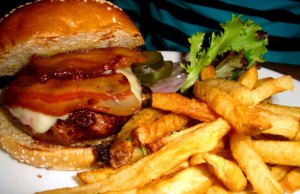
In fairness, my disinterested is also probably due it part to my post-vegetarian obsession with burgers. Y'all, I am REALLY REALLY SUPER PASSIONATE ABOUT BURGERS. Specifically bacon cheeseburgers. Cooked medium rare. Consumed with beer.
Mmmm. It's difficult to type right now, because my eyes are rolling back into my head just thinking about it.
But when you really, really love burgers, and you've had a really, really good burger, how can the slop they serve at Mickey D's possibly cut it?

A burger from Back Forty in New York - maybe the best burger I've ever had
Which, I believe, is an important point of this book. Appreciate your food. LOVE your food. Food is so quickly and cheaply available in this country that it's too easy to just eat without any real awareness of it. But when you take the time to truly love and appreciate your food, you will naturally choose good food, real food.
Which is, in fact, the next rule:
24. When you eat real food, you don't need rules
23. It’s not food if it’s called by the same name in every language (think Big Mac, Cheetos or Pringles).
Does this mean I can't get coffee from the Starbucks drive-thru?
Actually, the answer to that question is moot, as I tend not to drive a car anyway. And even if I did, I restrict my fast food intake to three times a year, maximum. I try to make it only once or twice. And junk food like Pringles and Cheetos have been generally banished from my belly for many years now, so that's no big deal either.
I used to love fast food. Even when I was a vegetarian - I orded the Fillet O'Fish. Who cares? It all tastes like the same salt-and-grease-soaked cardboard anyway. Mmmmm, grease and salt.
Anyway, I don't really know what happened. One day, I just... stoppped craving fast food. I think a part is due to the documentary Super Size Me, which I never saw, but heard enough about the massive weight gain and cholesterol spike, mood swings, sexual problems and other various health issues Mr. Spurlock suffered after eating nothing but McDonald's for a month straight to get the basic idea.
Think about it this way. I told myself. McDonald's products not only fail to nourish, they actually actively harm you. It's not just not-food, it's worse: it's anti-food.
Anti-food, anti-food, I'd think to myself whenever I was tempted during days of wandering the streets of New York looking for a decent lunch to stop wasting time and money and just buy a damn Wendy's cheeseburger.
And after a while, fast food actually stopped looking like food.
If only ALL my vices could be solved so easily.
In fairness, my disinterested is also probably due it part to my post-vegetarian obsession with burgers. Y'all, I am REALLY REALLY SUPER PASSIONATE ABOUT BURGERS. Specifically bacon cheeseburgers. Cooked medium rare. Consumed with beer.
Mmmm. It's difficult to type right now, because my eyes are rolling back into my head just thinking about it.
But when you really, really love burgers, and you've had a really, really good burger, how can the slop they serve at Mickey D's possibly cut it?
Which, I believe, is an important point of this book. Appreciate your food. LOVE your food. Food is so quickly and cheaply available in this country that it's too easy to just eat without any real awareness of it. But when you take the time to truly love and appreciate your food, you will naturally choose good food, real food.
Which is, in fact, the next rule:
24. When you eat real food, you don't need rules
Monday, March 12, 2012
Day 19
14. Eat only foods that will eventually rot.
15. Eat foods made from ingredients that you can picture in their raw state or growing in nature.
Rule 14 has been giving me trouble literally since day one.
On the first day of the project, when I awoke and realized woefully that there was absolutely nothing in the house that I could eat, I was hungry, grouchy, and - as usual - running late. I had a to make a snap decision. I reached for the healthiest, most natural-sounding cereal I could find - a box of Ezekiel 4:9 Golden Flax Cereal.

Ezekiel, for those of you who don't have some kind of wheat or gluten intolerance and/or have not gone completely off the health food deep end, is a brand of products inspired by the bible verse Ezekiel 4:9: "Take also unto thee wheat and barley and beans and lentils and millet and spelt and put them in one vessel and make bread of it." Which is exactly what Ezekiel has done.
If that sounds like a whole lot of things to stuff into one loaf of bread and sounds like it would be kind of gross... you're pretty much right. The cereal isn't bad, though, if you eat it with enough yogurt and fruit and honey. It's kind of like a really bland, really crunchy version of Grape Nuts. (And yes, I'm aware of how bland and crunchy Grape Nuts are in and of themselves - just think about that).
Anyway, the ingredients for Ezekiel 4:9 breakfast cereal are: sprouted wheat, filtered water, malted barley, flax seed, sprouted barely, sprouted millet, sprouted lentils, sprouted soybeans, sprouted spelt, sea salt.
In the pro's column, I understand every ingredient on this list, and they're all nourishing and whole. I can imagine them all in their raw state growing in nature. I've probably even actually kept every single one in my pantry at some point or another.
Admittedly, yes, there are more than five ingredients, but, as Pollan himself points out, there are lots of recipes that require more than five ingredients, so this rule by its very nature requires a certain degree of flexibility and common sense. And, if you don't count the water and salt, there's really only seven ingredients, so I'm going ahead and filing that one in the neutral column.
Harder to explain away, though is the fact that this cereal will not rot. It won't. This box's "best by" date is nearly a year from now, and I have a sneaking suspicion that it wouldn't really hurt to eat it past then either.
Why is this important? Because, as Pollan explains, food going bad is usually a process of bacteria or fungi feeding on the nutrients in the food just like us. A longer shelf-life means less nutrients. Real food with real nutrients should generally go bad. Meat goes rancid, bread gets moldy, fruits and vegetables rot. Cereal... sits in the cupboard for years and years.
On the other hand, there are exceptions. Pollan points out honey, which has an almost eternal shelf-life. Is this an exeception? Maybe it is. The ingredients are undeniably natural and healthful. But something tells me it's not an exception. I can't explain it, but it feels processed. Ezekiel 4:9 cereal, for all its touted benefits (and yes - it touts them loudly, thus violating Rule 8 and planting another seed of doubt in my mind) is not found in nature, does not simply have a naturally long shelf-life.
In the end, I decided ya know what? It doesn't rot. It comes in a box, it was not cooked by humans (Rule 19) nor can I even imagine it being cooked by humans. So the answer is no.

Seriously - how would a human being make those little pellets in a kitchen?
But I don't know. I don't know. So I bring up the Ezekiel question because it's an example of where even these rules, designed to be so simple, so practical - Eat food. Mostly plants. Not too much. - fail me.
Yes, it makes health claims, but they kind of seem like legitimate health claims. (An excerpt from the box: "We discovered that when these [ingredients] are sprouted and combined... a complete protein is created that is... 84.3% as efficient as the highest recognized source of protein.")
And yes, it has more than five ingredients, but they're all wholesome, nutritious ingredients. No strange preservatives, additives or flavorings.
And yes, it will not rot. But... maybe that's okay? Sometimes it is.
This is the point, I think, where common sense should prevail over rule-following pendantry. But where is common sense? I can't find it. To me, the Ezekiel Issue brings to harsh light just how complicated the question of food has become in our society. Our understanding of what we put in our bodies is so obscured, we can't even trust our own common sense and good judgement. The simple question of what to eat for breakfast becomes a trip down the rabbit hole, and I have no answers to give.
15. Eat foods made from ingredients that you can picture in their raw state or growing in nature.
Rule 14 has been giving me trouble literally since day one.
On the first day of the project, when I awoke and realized woefully that there was absolutely nothing in the house that I could eat, I was hungry, grouchy, and - as usual - running late. I had a to make a snap decision. I reached for the healthiest, most natural-sounding cereal I could find - a box of Ezekiel 4:9 Golden Flax Cereal.

Ezekiel, for those of you who don't have some kind of wheat or gluten intolerance and/or have not gone completely off the health food deep end, is a brand of products inspired by the bible verse Ezekiel 4:9: "Take also unto thee wheat and barley and beans and lentils and millet and spelt and put them in one vessel and make bread of it." Which is exactly what Ezekiel has done.
If that sounds like a whole lot of things to stuff into one loaf of bread and sounds like it would be kind of gross... you're pretty much right. The cereal isn't bad, though, if you eat it with enough yogurt and fruit and honey. It's kind of like a really bland, really crunchy version of Grape Nuts. (And yes, I'm aware of how bland and crunchy Grape Nuts are in and of themselves - just think about that).
Anyway, the ingredients for Ezekiel 4:9 breakfast cereal are: sprouted wheat, filtered water, malted barley, flax seed, sprouted barely, sprouted millet, sprouted lentils, sprouted soybeans, sprouted spelt, sea salt.
In the pro's column, I understand every ingredient on this list, and they're all nourishing and whole. I can imagine them all in their raw state growing in nature. I've probably even actually kept every single one in my pantry at some point or another.
Admittedly, yes, there are more than five ingredients, but, as Pollan himself points out, there are lots of recipes that require more than five ingredients, so this rule by its very nature requires a certain degree of flexibility and common sense. And, if you don't count the water and salt, there's really only seven ingredients, so I'm going ahead and filing that one in the neutral column.
Harder to explain away, though is the fact that this cereal will not rot. It won't. This box's "best by" date is nearly a year from now, and I have a sneaking suspicion that it wouldn't really hurt to eat it past then either.
Why is this important? Because, as Pollan explains, food going bad is usually a process of bacteria or fungi feeding on the nutrients in the food just like us. A longer shelf-life means less nutrients. Real food with real nutrients should generally go bad. Meat goes rancid, bread gets moldy, fruits and vegetables rot. Cereal... sits in the cupboard for years and years.
On the other hand, there are exceptions. Pollan points out honey, which has an almost eternal shelf-life. Is this an exeception? Maybe it is. The ingredients are undeniably natural and healthful. But something tells me it's not an exception. I can't explain it, but it feels processed. Ezekiel 4:9 cereal, for all its touted benefits (and yes - it touts them loudly, thus violating Rule 8 and planting another seed of doubt in my mind) is not found in nature, does not simply have a naturally long shelf-life.
In the end, I decided ya know what? It doesn't rot. It comes in a box, it was not cooked by humans (Rule 19) nor can I even imagine it being cooked by humans. So the answer is no.

But I don't know. I don't know. So I bring up the Ezekiel question because it's an example of where even these rules, designed to be so simple, so practical - Eat food. Mostly plants. Not too much. - fail me.
Yes, it makes health claims, but they kind of seem like legitimate health claims. (An excerpt from the box: "We discovered that when these [ingredients] are sprouted and combined... a complete protein is created that is... 84.3% as efficient as the highest recognized source of protein.")
And yes, it has more than five ingredients, but they're all wholesome, nutritious ingredients. No strange preservatives, additives or flavorings.
And yes, it will not rot. But... maybe that's okay? Sometimes it is.
This is the point, I think, where common sense should prevail over rule-following pendantry. But where is common sense? I can't find it. To me, the Ezekiel Issue brings to harsh light just how complicated the question of food has become in our society. Our understanding of what we put in our bodies is so obscured, we can't even trust our own common sense and good judgement. The simple question of what to eat for breakfast becomes a trip down the rabbit hole, and I have no answers to give.
Wednesday, March 7, 2012
Day 14
10. Avoid foods that are pretending to be something they are not.
11. Avoid foods you see advertised on television.
Rule 11 has proved to be a pretty easy rule to follow. I don't think I eat anything I see advertised on television and, come to think of it, I don't really watch television (Hulu and Netflix are my poison). Still, I did a quick scan of the refrigerator just to be on the safe side. The only offenders, as far as I can remember of commercials, were cream cheese and milk.
But milk doesn't count... right? I realize this is the second post in a row where I've invoked an exception for milk but they both seem valid. Am I in total denial here? I know I love my dairy, but I don't think I'm just making excuses. Michael Pollan doesn't want me to be a vegan... does he?
Anyway, other than that, Rule 11 hasn't proved much of a sticking point. Rule 10, on the other hand, is a sad, sad rule. A good rule. A necessary rule. But a sad rule. Because with it, I must say goodbye to one of my favorite foods, one that has been my delicious companion since age thirteen. My best and most beloved discovery in my days as a vegetarian:

Morningstar Farms' veggie buffalo wings. These things are so delicious, I kept eating them long after I renounced vegetarianism; I still eat them today. And, lamentably, consider them a "healthy" alternative to regular buffalo wings. I never even considered how highly processed food has got to be to get vegetables to look, feel, and taste like meat.
Still, even without taking that into consideration, I think deep down, I knew I was fooling myself.
I should have stopped eating them up back in high school when I found out they were made with GMOs. (At least they're honest about it: says so right in their FAQs.) But I just didn't want to give them up. Like so many other times, I figured the list of ingredients I disapproved of was beyond my control. Instead, my mom and I wrote a letter to the company registering our discontent and requesting that they discontinue their use of genetically modified products and I closed the book on that.
It's funny, I used to eat these with delight in high school (and even college), taking pleasure in my moral high-ground because they were made without the needless deaths of animals. Now, when I consider the damage the mega-industrialization of food does to the people, animals and plants it touches, I think the less cruel choice is to just eat the damn chicken meat. Provided, of course, that the chickens come from small, humane farms and not huge, industrial factories.

Image found at www.veganoutreach.org
Doesn't that look yummy? Happy hump day, everybody!
11. Avoid foods you see advertised on television.
Rule 11 has proved to be a pretty easy rule to follow. I don't think I eat anything I see advertised on television and, come to think of it, I don't really watch television (Hulu and Netflix are my poison). Still, I did a quick scan of the refrigerator just to be on the safe side. The only offenders, as far as I can remember of commercials, were cream cheese and milk.
But milk doesn't count... right? I realize this is the second post in a row where I've invoked an exception for milk but they both seem valid. Am I in total denial here? I know I love my dairy, but I don't think I'm just making excuses. Michael Pollan doesn't want me to be a vegan... does he?
Anyway, other than that, Rule 11 hasn't proved much of a sticking point. Rule 10, on the other hand, is a sad, sad rule. A good rule. A necessary rule. But a sad rule. Because with it, I must say goodbye to one of my favorite foods, one that has been my delicious companion since age thirteen. My best and most beloved discovery in my days as a vegetarian:

Morningstar Farms' veggie buffalo wings. These things are so delicious, I kept eating them long after I renounced vegetarianism; I still eat them today. And, lamentably, consider them a "healthy" alternative to regular buffalo wings. I never even considered how highly processed food has got to be to get vegetables to look, feel, and taste like meat.
Still, even without taking that into consideration, I think deep down, I knew I was fooling myself.
I should have stopped eating them up back in high school when I found out they were made with GMOs. (At least they're honest about it: says so right in their FAQs.) But I just didn't want to give them up. Like so many other times, I figured the list of ingredients I disapproved of was beyond my control. Instead, my mom and I wrote a letter to the company registering our discontent and requesting that they discontinue their use of genetically modified products and I closed the book on that.
It's funny, I used to eat these with delight in high school (and even college), taking pleasure in my moral high-ground because they were made without the needless deaths of animals. Now, when I consider the damage the mega-industrialization of food does to the people, animals and plants it touches, I think the less cruel choice is to just eat the damn chicken meat. Provided, of course, that the chickens come from small, humane farms and not huge, industrial factories.

Doesn't that look yummy? Happy hump day, everybody!
Friday, March 2, 2012
Day 9
6. Avoid food products that have more than 5 ingredients.
Related to yesterday, while raiding my refrigerator and pantry, I happened across these crackers.

While they don't contain high fructose corn syrup, and they don't list a sweetner among the top three ingredients, they do have way more than five ingredients. And some of them sound way more like science experiments than actual food.
The thing is, prior to this experiment, I would have put these guys on the Good List. I'm always pretty conscious of eating healthily, and I would have certainly rated these crackers among the acceptable, healthy things I could put in my body: they're low enough in calories, they're not fried in grease, they've got some whole grain in them.
It's not that I wouldn't have noticed the modified corn starch, invert syrup, sodium bicarbonate and monocalcium phosphate. Aversion to words like that has been drilled into me since childhood. It's just that I would have accepted it. Boxed foods come with words on the side that make you sad, and there's nothing you can do about it. And crackers come in boxes, so if you wanna eat crackers...
This is what it's about: I thought I didn't have a choice. Now, following the Food Rules, these crackers fall so far outside the bounds of what I can eat it's unbelievable. So I avoid them. And I haven't missed them.
Since I've gotten over my initial shock, I've been eating well. There are plenty of good, fresh options for meals and snacks that have nothing to do with these crackers. Even if my standards were considerably less rigid than they are for this project, there's no reason to seek out this box or others like it.
I know I spent a fair bit of time yesterday complaining about how little choice I have about how certain foods are processed, and that's true, and it still makes me angry. But I also discovered yesterday how complacent I've been, without even realizing it.
I do have a choice. I have more of a choice than I thought I did. If I'm just a little more aware and a little conscientious, I don't have to accept the little boxes I am given.
Related to yesterday, while raiding my refrigerator and pantry, I happened across these crackers.

While they don't contain high fructose corn syrup, and they don't list a sweetner among the top three ingredients, they do have way more than five ingredients. And some of them sound way more like science experiments than actual food.
The thing is, prior to this experiment, I would have put these guys on the Good List. I'm always pretty conscious of eating healthily, and I would have certainly rated these crackers among the acceptable, healthy things I could put in my body: they're low enough in calories, they're not fried in grease, they've got some whole grain in them.
It's not that I wouldn't have noticed the modified corn starch, invert syrup, sodium bicarbonate and monocalcium phosphate. Aversion to words like that has been drilled into me since childhood. It's just that I would have accepted it. Boxed foods come with words on the side that make you sad, and there's nothing you can do about it. And crackers come in boxes, so if you wanna eat crackers...
This is what it's about: I thought I didn't have a choice. Now, following the Food Rules, these crackers fall so far outside the bounds of what I can eat it's unbelievable. So I avoid them. And I haven't missed them.
Since I've gotten over my initial shock, I've been eating well. There are plenty of good, fresh options for meals and snacks that have nothing to do with these crackers. Even if my standards were considerably less rigid than they are for this project, there's no reason to seek out this box or others like it.
I know I spent a fair bit of time yesterday complaining about how little choice I have about how certain foods are processed, and that's true, and it still makes me angry. But I also discovered yesterday how complacent I've been, without even realizing it.
I do have a choice. I have more of a choice than I thought I did. If I'm just a little more aware and a little conscientious, I don't have to accept the little boxes I am given.
Thursday, March 1, 2012
Day 8
4. Avoid food products that contain high-fructose corn syrup.
5. Avoid food products that have some form of sugar (or sweetener listed among) the top three ingredients.
For my ninth birthday party, I had begged my parents for Crystal Pepsi. Remember Crystal Pepsi? I was obsessed with it. It tasted like Pepsi! But it was totally clear! Amazing! I was dying to try it, but my parents, health nuts even in the 80's before it became du jour, forbade it. They made an exception for my special day, though, and I could not wait. The first thing I did when my first guest, a sweet mousy girl named Shannon, arrived was foist a tall glass of Crystal Pepsi upon her.
"Does this have sugar in it?" she asked. "My mom says I'm not allowed to have sugar. It makes me too hyper."
"I don't know," I said. "Let's check." We read the ingredients together; I didn't understand a full two-thirds of them, but none of them were sugar. "Good to go," I said, and handed her her glass.
Needless to say, she went bananas.
That was the moment when I learned that lots of labels say "high fructose corn syrup" when they mean to say "sugar." It eventually became filed under the list of the villianous, unpronouncable ingredients, like potassium sulfate and sodium bicarbonate, that my mom constantly denounced but that still popped up in most everything, so I came to understand as unavoidable evils, like cancer, or homework.
It wasn't until I read the Omnivore's Dilemma in college that I got an idea of just how disruptive the ubiquitousness of high fructose corn syrup is both to the environment and to our health.
And, even my mom, the devoted health nut, had a whole slew of offenders lurking in her refrigerator.

Lots of these items, like the chocolate syrup and the Oreo-bits were bought for special occasions and then squirreled away for years, I'd be willing to guess, until I brought them to light for this photo.
Others, though, are everyday items, and it appears as though the worst offenders are the condiments. Ketchup, barbecue sauce, pickles, etc. I actually remember the day I bought those sweet pickles. I searched the entire store thrice over, and could not believe that I could not buy a single jar of pickles that didn't contain high fructose corn syrup.
How cruel, as condiments are just about the hardest to replace with homemade or at least person-made equivalents. In fact, that's probably exactly why condiments are the last bastion of high fructose corn syrup in our refrigerator. There's no simple alternative.
Case in point: I got super-excited to share a family recipe for homemade barbecue sauce that is utterly delicious, until I realized that the first ingredient is ketchup. Womp-womp.
This isn't necessarily a problem for this project - worst comes to worst, I can live without ketchup for six weeks. But what if I want to get away from the processed over-sweetened goop they sell in the supermarket post-Lent? Well, you can buy these newfangled "all natural" versions of ketchup they sell now, but they still break the other two of the three rules listed today, and about a million other rules as well. And you can certainly try your hand at homemade ketchup, but it only keeps for about a month, and I use ketchup maybe once every two months. Also, to be blunt, it looks like a real bitch to make.
What does one do here? I'm a big believer in voting with my money, and I'm a little irked that there's no way for me to cast my vote here, even if I wanted to. Part of me, the rational part of me, says, Ya know, you can't win them all. You don't even eat ketchup that much, so when you do, just buy the crap in the bottle.
But then the other part of me, the part that thought this project was a good idea in the first place, says, Don't let the man win!!!
What do you think? What would you do? Would you stick to your guns, no matter how it might affect your ketchup consumption? Or would you accept the fact that as long as the food industry exists as we know it, long lists of "edible foodlike substances" will eventually worm their way into our lives - an inevitable evil, like I once believed?
5. Avoid food products that have some form of sugar (or sweetener listed among) the top three ingredients.
For my ninth birthday party, I had begged my parents for Crystal Pepsi. Remember Crystal Pepsi? I was obsessed with it. It tasted like Pepsi! But it was totally clear! Amazing! I was dying to try it, but my parents, health nuts even in the 80's before it became du jour, forbade it. They made an exception for my special day, though, and I could not wait. The first thing I did when my first guest, a sweet mousy girl named Shannon, arrived was foist a tall glass of Crystal Pepsi upon her.
"Does this have sugar in it?" she asked. "My mom says I'm not allowed to have sugar. It makes me too hyper."
"I don't know," I said. "Let's check." We read the ingredients together; I didn't understand a full two-thirds of them, but none of them were sugar. "Good to go," I said, and handed her her glass.
Needless to say, she went bananas.
That was the moment when I learned that lots of labels say "high fructose corn syrup" when they mean to say "sugar." It eventually became filed under the list of the villianous, unpronouncable ingredients, like potassium sulfate and sodium bicarbonate, that my mom constantly denounced but that still popped up in most everything, so I came to understand as unavoidable evils, like cancer, or homework.
It wasn't until I read the Omnivore's Dilemma in college that I got an idea of just how disruptive the ubiquitousness of high fructose corn syrup is both to the environment and to our health.
And, even my mom, the devoted health nut, had a whole slew of offenders lurking in her refrigerator.

Lots of these items, like the chocolate syrup and the Oreo-bits were bought for special occasions and then squirreled away for years, I'd be willing to guess, until I brought them to light for this photo.
Others, though, are everyday items, and it appears as though the worst offenders are the condiments. Ketchup, barbecue sauce, pickles, etc. I actually remember the day I bought those sweet pickles. I searched the entire store thrice over, and could not believe that I could not buy a single jar of pickles that didn't contain high fructose corn syrup.
How cruel, as condiments are just about the hardest to replace with homemade or at least person-made equivalents. In fact, that's probably exactly why condiments are the last bastion of high fructose corn syrup in our refrigerator. There's no simple alternative.
Case in point: I got super-excited to share a family recipe for homemade barbecue sauce that is utterly delicious, until I realized that the first ingredient is ketchup. Womp-womp.
This isn't necessarily a problem for this project - worst comes to worst, I can live without ketchup for six weeks. But what if I want to get away from the processed over-sweetened goop they sell in the supermarket post-Lent? Well, you can buy these newfangled "all natural" versions of ketchup they sell now, but they still break the other two of the three rules listed today, and about a million other rules as well. And you can certainly try your hand at homemade ketchup, but it only keeps for about a month, and I use ketchup maybe once every two months. Also, to be blunt, it looks like a real bitch to make.
What does one do here? I'm a big believer in voting with my money, and I'm a little irked that there's no way for me to cast my vote here, even if I wanted to. Part of me, the rational part of me, says, Ya know, you can't win them all. You don't even eat ketchup that much, so when you do, just buy the crap in the bottle.
But then the other part of me, the part that thought this project was a good idea in the first place, says, Don't let the man win!!!
What do you think? What would you do? Would you stick to your guns, no matter how it might affect your ketchup consumption? Or would you accept the fact that as long as the food industry exists as we know it, long lists of "edible foodlike substances" will eventually worm their way into our lives - an inevitable evil, like I once believed?
Subscribe to:
Posts (Atom)