I have to share my breakfast - inspired by the food from Farm and Table. It was so successful I had it almost every morning this week. As most everyone knows, I'm working for an new restaurant in town that is not only amazing and exciting in lots of different ways, but also falls really perfectly in line with what I'm doing with this project. Also, our food is pretty undeniably amazing.
One of the items of the brunch menu is a traditional New Mexican staple, which, shamefully, I had never heard of before, called atole. Atole is a kind of cornmeal porridge made from toasted masa and here in New Mexico, it's made specifically from blue corn masa. When I tried it for the first time at Farm & Table, it was (unsurprisingly) amazing, so when I saw a bin of atole flour at the co-op while cruising for new, rules-happy meal, how could I not take some to try?
Finding a recipe online was a little difficult, since it turns out that New Mexican atole is different from traditional atole, but when I finally found one that looked right, I was surprised and skeptical about how quick and simple was supposed to be. It's basically just flour and water:
Ingredients
1 cup blue corn meal
2 cups milk
2 cups water
Sugar to taste
1/2 tsp salt
Directions
Mix blue corn meal, salt and water and bring to boil, stirring constantly. Add milk and stir until thickened. Serve hot and add sugar to taste.
See? And it actually was that easy. AND it only took about 5 minutes, AND it made enough to last the entire week.
Now, I know what amounts to a bowl of flour isn't exactly the best way to start a morning, and as a result this sadly won't turn into an every day thing, but atole is a very traditional food and thus, in my opinion, falls into the category of Rule 48 (Eat more like the French. Or the Japanese. Or the Italians. Or the Greeks), and thus, in my opinion, gets the thumbs up. Or maybe I'm just trying to justify continuing to make this delicious food.
Because, most importantly, it tasted great.
I added a little maple syrup, some walnuts and some strawberries, but the possibilities of how to dress it up are endless. My friend Monica used to add cinnamon sticks and cardemom pods to the water she boiled our oatmeal in - I'm wondering how that would taste with atole. I bet it's amazing.
I'm not sure how readily available blue corn atole flour is outside New Mexico, so this might be just a completely worthless post if you're located outside of the Land of Enchantment. But I think I've seen this brand sold all the way out in New York, so don't lose hope! It's definitely worth looking into.
Showing posts with label omnomnom. Show all posts
Tuesday, March 27, 2012
Tuesday, March 20, 2012
Day 27
22. It’s not food if it arrived through the window of your car
23. It’s not food if it’s called by the same name in every language (think Big Mac, Cheetos or Pringles).
Does this mean I can't get coffee from the Starbucks drive-thru?
Actually, the answer to that question is moot, as I tend not to drive a car anyway. And even if I did, I restrict my fast food intake to three times a year, maximum. I try to make it only once or twice. And junk food like Pringles and Cheetos have been generally banished from my belly for many years now, so that's no big deal either.
I used to love fast food. Even when I was a vegetarian - I orded the Fillet O'Fish. Who cares? It all tastes like the same salt-and-grease-soaked cardboard anyway. Mmmmm, grease and salt.
Anyway, I don't really know what happened. One day, I just... stoppped craving fast food. I think a part is due to the documentary Super Size Me, which I never saw, but heard enough about the massive weight gain and cholesterol spike, mood swings, sexual problems and other various health issues Mr. Spurlock suffered after eating nothing but McDonald's for a month straight to get the basic idea.
Think about it this way. I told myself. McDonald's products not only fail to nourish, they actually actively harm you. It's not just not-food, it's worse: it's anti-food.
Anti-food, anti-food, I'd think to myself whenever I was tempted during days of wandering the streets of New York looking for a decent lunch to stop wasting time and money and just buy a damn Wendy's cheeseburger.
And after a while, fast food actually stopped looking like food.
If only ALL my vices could be solved so easily.
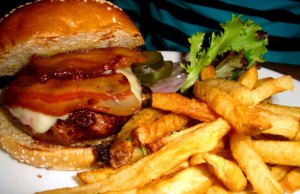
In fairness, my disinterested is also probably due it part to my post-vegetarian obsession with burgers. Y'all, I am REALLY REALLY SUPER PASSIONATE ABOUT BURGERS. Specifically bacon cheeseburgers. Cooked medium rare. Consumed with beer.
Mmmm. It's difficult to type right now, because my eyes are rolling back into my head just thinking about it.
But when you really, really love burgers, and you've had a really, really good burger, how can the slop they serve at Mickey D's possibly cut it?
A burger from Back Forty in New York - maybe the best burger I've ever had
Which, I believe, is an important point of this book. Appreciate your food. LOVE your food. Food is so quickly and cheaply available in this country that it's too easy to just eat without any real awareness of it. But when you take the time to truly love and appreciate your food, you will naturally choose good food, real food.
Which is, in fact, the next rule:
24. When you eat real food, you don't need rules
23. It’s not food if it’s called by the same name in every language (think Big Mac, Cheetos or Pringles).
Does this mean I can't get coffee from the Starbucks drive-thru?
Actually, the answer to that question is moot, as I tend not to drive a car anyway. And even if I did, I restrict my fast food intake to three times a year, maximum. I try to make it only once or twice. And junk food like Pringles and Cheetos have been generally banished from my belly for many years now, so that's no big deal either.
I used to love fast food. Even when I was a vegetarian - I orded the Fillet O'Fish. Who cares? It all tastes like the same salt-and-grease-soaked cardboard anyway. Mmmmm, grease and salt.
Anyway, I don't really know what happened. One day, I just... stoppped craving fast food. I think a part is due to the documentary Super Size Me, which I never saw, but heard enough about the massive weight gain and cholesterol spike, mood swings, sexual problems and other various health issues Mr. Spurlock suffered after eating nothing but McDonald's for a month straight to get the basic idea.
Think about it this way. I told myself. McDonald's products not only fail to nourish, they actually actively harm you. It's not just not-food, it's worse: it's anti-food.
Anti-food, anti-food, I'd think to myself whenever I was tempted during days of wandering the streets of New York looking for a decent lunch to stop wasting time and money and just buy a damn Wendy's cheeseburger.
And after a while, fast food actually stopped looking like food.
If only ALL my vices could be solved so easily.
In fairness, my disinterested is also probably due it part to my post-vegetarian obsession with burgers. Y'all, I am REALLY REALLY SUPER PASSIONATE ABOUT BURGERS. Specifically bacon cheeseburgers. Cooked medium rare. Consumed with beer.
Mmmm. It's difficult to type right now, because my eyes are rolling back into my head just thinking about it.
But when you really, really love burgers, and you've had a really, really good burger, how can the slop they serve at Mickey D's possibly cut it?
Which, I believe, is an important point of this book. Appreciate your food. LOVE your food. Food is so quickly and cheaply available in this country that it's too easy to just eat without any real awareness of it. But when you take the time to truly love and appreciate your food, you will naturally choose good food, real food.
Which is, in fact, the next rule:
24. When you eat real food, you don't need rules
Wednesday, March 14, 2012
Day 21
So after I made my delicious loaf of bread, I tried to make my first sandwich in almost three weeks, and realized almost immediately that the mayonnaise in the fridge was off-limits. Which makes for, in my book at least, a pretty weak sandwich. And I wasn't going to tolerate that. I FINALLY made a loaf of bread. I was FINALLY going to get to make a sandwich. It was GOING to be a delicious sandwich. It was GOING to have mayo.
I found a recipe from my favorite Food Network personality and, because I trust Alton with my whole heart and soul, I dove right in.
And let me tell you, there was a lot of trust involved with this recipe. In further demonstration of my food ignorance, until last night I had never actually seen mayonnaise made before. And, while I knew that it was basically eggs and oil and vinegar, I never really thought about it until I saw the recipe. At which point I thought, Really? I'm just going to mix up some oil with an egg yolk and it's going to turn into mayonnaise and not just a big, greasy, liquidy mess? I was highly skeptical.
As per Alton's instructions, I whisked one egg yolk with 1/2 teaspoon fine salt, 1/2 teaspoon dry mustard, and 2 pinches sugar.
So far so good...
After that, you mix 2 teaspoons fresh squeezed lemon juice and 1 tablespoon white wine vinegar together in a separate measuring cup and then pour about half of it into the egg yolk mixture and whisk HARD until you get an emulsion.
Or, so I'm told. You're supposed to whisk until the mixture gets a little bit lighter and thicker, although I whisked for a good long time and didn't see much of a change. Eventually, I just thought, Well, hope that's good enough... and prayed I didn't totally screw it up.
And I didn't! To my complete surprise, as I dropped a few drops of oil into the mixture and continued to whisk hard, a mayonnaise-like substance actually began to form.
Whaaaat!?
So after the mixture starts looking like mayo, you can ease up a little and start pouring the oil in a thin, steady stream. Which is kind of a two-person job. If you don't have a second person, you can make it in the food processor, or, if you're like me and you don't have a second person and you don't realize until you're pretty much done that there was a much easier way to do this, I found that alternately adding the oil in small quantities and whisking worked just fine.
This was also the only place I differed with Alton. He says to use safflower or corn oil, but since I'm not sure if you can get either of those oils through stone-grinding (Rule 42) and I was too lazy to check, I went with olive oil. Olive oil will apparently make a darker mayonnaise with a distinct olive oil flavor, which, to me, is a total plus.
Anyway from there it's pretty easy - just slowly add half the oil, then the other half of the vinegar and lemon juice, then the other half of the oil (still slowly) and whisk until your arm falls off! Mayonnaise!
From start to finish, the whole project probably took about 20 minutes and, unlike ketchup, was not a pain in the ass at all. The recipe made enough mayo to last me longer than it will probably keep, which, according to Alton, is a week. Not gonna lie, I'll probably try and eat it for two. If I don't die, I'll report back with my findings.
The end result, by the way was fresh and delicious. I don't think I even knew what real mayo is supposed to taste like. I can tell already that it's going to blend with other ingredients like lemon and dill or roasted garlic way better than bottled mayo, which makes me nerdily excited. Aioli time!
I found a recipe from my favorite Food Network personality and, because I trust Alton with my whole heart and soul, I dove right in.
And let me tell you, there was a lot of trust involved with this recipe. In further demonstration of my food ignorance, until last night I had never actually seen mayonnaise made before. And, while I knew that it was basically eggs and oil and vinegar, I never really thought about it until I saw the recipe. At which point I thought, Really? I'm just going to mix up some oil with an egg yolk and it's going to turn into mayonnaise and not just a big, greasy, liquidy mess? I was highly skeptical.
As per Alton's instructions, I whisked one egg yolk with 1/2 teaspoon fine salt, 1/2 teaspoon dry mustard, and 2 pinches sugar.
After that, you mix 2 teaspoons fresh squeezed lemon juice and 1 tablespoon white wine vinegar together in a separate measuring cup and then pour about half of it into the egg yolk mixture and whisk HARD until you get an emulsion.
Or, so I'm told. You're supposed to whisk until the mixture gets a little bit lighter and thicker, although I whisked for a good long time and didn't see much of a change. Eventually, I just thought, Well, hope that's good enough... and prayed I didn't totally screw it up.
And I didn't! To my complete surprise, as I dropped a few drops of oil into the mixture and continued to whisk hard, a mayonnaise-like substance actually began to form.
So after the mixture starts looking like mayo, you can ease up a little and start pouring the oil in a thin, steady stream. Which is kind of a two-person job. If you don't have a second person, you can make it in the food processor, or, if you're like me and you don't have a second person and you don't realize until you're pretty much done that there was a much easier way to do this, I found that alternately adding the oil in small quantities and whisking worked just fine.
This was also the only place I differed with Alton. He says to use safflower or corn oil, but since I'm not sure if you can get either of those oils through stone-grinding (Rule 42) and I was too lazy to check, I went with olive oil. Olive oil will apparently make a darker mayonnaise with a distinct olive oil flavor, which, to me, is a total plus.
Anyway from there it's pretty easy - just slowly add half the oil, then the other half of the vinegar and lemon juice, then the other half of the oil (still slowly) and whisk until your arm falls off! Mayonnaise!
From start to finish, the whole project probably took about 20 minutes and, unlike ketchup, was not a pain in the ass at all. The recipe made enough mayo to last me longer than it will probably keep, which, according to Alton, is a week. Not gonna lie, I'll probably try and eat it for two. If I don't die, I'll report back with my findings.
The end result, by the way was fresh and delicious. I don't think I even knew what real mayo is supposed to taste like. I can tell already that it's going to blend with other ingredients like lemon and dill or roasted garlic way better than bottled mayo, which makes me nerdily excited. Aioli time!
Tuesday, March 13, 2012
Day 20
16. Go food shopping every week.
17. Buy your snacks at the farmers market.
18. Eat close to the earth.
While I can't shake the image of eating my dinner from a seat on the floor, Japanese-style, that's not actually what Michael Pollan means when he says Eat close to the earth. What he means is to try and eat your food as close as possible to the moment when the earth offers it up. Shorten the journey it takes to your plate; eliminate any and every step on that journey that you can.
The reasons for this rule are abundant, ranging from the practical (the shorter the journey, the less fossil fuels burned transporting it to you, and the less opportunities for unknown entities to fill your food with additives) to the more abstract (if your food comes from nearby, you're likely to be more knowledgable about it and thus make better choices) to the philosophical (the more connected you are to your food, the more connected you will be to yourself, your body, and the world around you.)
The ideal, of course, is to pick the apple straight off the tree, though most of us can't just go foraging for our food. Still, there are things we can do: we can buy as local as possible. We can shop at the farmer's market instead of the supermarket. We can make food for ourselves where we would have let others make it in the past.
For me, what this is has come down to is if there is a reasonably feasible way to shorten the distance to my plate, I have to take it. If there is a local option, I have to buy it and if there's a way to live without it when there's not a local option, I have to live without it.
And I can't buy bread. I know this sounds pretty arbitrary - bread, especially if its purchased from a bakery or farmer's market, is a pretty innocuous entity; not really a Food Rules offender in any other way - but stay with me. And here's the thing: baking bread is SO SIMPLE. I might not be able to make my own cheese, or raise my own chickens, but gosh darn it, I can make bread. It's not that hard. And it's even less hard if you own a bread maker, like my parents do.
I'll admit it, I love bread makers. I'm not ashamed. Back in New York, in my shoebox-sized apartment, I dreamed of the day when I would have enough space to store my own bread maker. That, and a coffee maker that ran on a timer. Then I'd set both of them to go off in the early morning, and I'd wake up to warm, homemade bread and freshly brewed coffee all the time. It would be paradise; I'd live like royalty while my robot servants did my bidding.
So yeah, I love bread makers. I know all the hardcore bakers and chefs out there will say that using a bread maker is second rate; I even know a few people who would go so far as to say that when you use the machine instead of making the bread yourself, you are depriving yourself of a sacred task that has been man's birthright almost since the day we discovered fire. I get that. I mean, this project is about getting closer to the process that brings you your food, and one can make an argument that a bread maker is a step in the opposite direction.
But from my perspective, there's something so visceral about seeing the raw ingredients, and combining them yourself, even if "combining" them is just dumping them into a box and pressing start. And - seriously - that is all you have to do. To me, for the purposes of this experiment, that makes it almost unconscionable to go out and buy a loaf of bread - no matter how good and fresh it is.
And that's also why I am SO PROUD OF MYSELF for finally, FINALLY getting around to making a loaf of bread. I've been living essentially bread-free with the occasional exceptions of sandwiches from Flying Star and a few pieces here and there from Farm & Table. It's made for some very sad mornings full of eggs with no toast and some equally frustrating sandwich-less lunches.
This was the first time my parents' machine had been used for anything except kneading dough (what a waste!), and when the finished product came out looking more like a bread cube than a bread loaf I was skeptical.
But it was delicious. Oh, it was so delicious! Soft! And moist! And about as fluffy as whole wheat bread can be! Even though MP specifically instructs me to limit my snacks to unprocessed plant foods (Rule 72), I think the obvious exception is "unless there's still-warm fresh-baked bread." I had a slice of it piping hot, right out of the oven -er- machine, with butter and local honey.
I swear to you, I have never loved any bread more than I loved that slice.
17. Buy your snacks at the farmers market.
18. Eat close to the earth.
While I can't shake the image of eating my dinner from a seat on the floor, Japanese-style, that's not actually what Michael Pollan means when he says Eat close to the earth. What he means is to try and eat your food as close as possible to the moment when the earth offers it up. Shorten the journey it takes to your plate; eliminate any and every step on that journey that you can.
The reasons for this rule are abundant, ranging from the practical (the shorter the journey, the less fossil fuels burned transporting it to you, and the less opportunities for unknown entities to fill your food with additives) to the more abstract (if your food comes from nearby, you're likely to be more knowledgable about it and thus make better choices) to the philosophical (the more connected you are to your food, the more connected you will be to yourself, your body, and the world around you.)
The ideal, of course, is to pick the apple straight off the tree, though most of us can't just go foraging for our food. Still, there are things we can do: we can buy as local as possible. We can shop at the farmer's market instead of the supermarket. We can make food for ourselves where we would have let others make it in the past.
For me, what this is has come down to is if there is a reasonably feasible way to shorten the distance to my plate, I have to take it. If there is a local option, I have to buy it and if there's a way to live without it when there's not a local option, I have to live without it.
And I can't buy bread. I know this sounds pretty arbitrary - bread, especially if its purchased from a bakery or farmer's market, is a pretty innocuous entity; not really a Food Rules offender in any other way - but stay with me. And here's the thing: baking bread is SO SIMPLE. I might not be able to make my own cheese, or raise my own chickens, but gosh darn it, I can make bread. It's not that hard. And it's even less hard if you own a bread maker, like my parents do.
I'll admit it, I love bread makers. I'm not ashamed. Back in New York, in my shoebox-sized apartment, I dreamed of the day when I would have enough space to store my own bread maker. That, and a coffee maker that ran on a timer. Then I'd set both of them to go off in the early morning, and I'd wake up to warm, homemade bread and freshly brewed coffee all the time. It would be paradise; I'd live like royalty while my robot servants did my bidding.
So yeah, I love bread makers. I know all the hardcore bakers and chefs out there will say that using a bread maker is second rate; I even know a few people who would go so far as to say that when you use the machine instead of making the bread yourself, you are depriving yourself of a sacred task that has been man's birthright almost since the day we discovered fire. I get that. I mean, this project is about getting closer to the process that brings you your food, and one can make an argument that a bread maker is a step in the opposite direction.
But from my perspective, there's something so visceral about seeing the raw ingredients, and combining them yourself, even if "combining" them is just dumping them into a box and pressing start. And - seriously - that is all you have to do. To me, for the purposes of this experiment, that makes it almost unconscionable to go out and buy a loaf of bread - no matter how good and fresh it is.
And that's also why I am SO PROUD OF MYSELF for finally, FINALLY getting around to making a loaf of bread. I've been living essentially bread-free with the occasional exceptions of sandwiches from Flying Star and a few pieces here and there from Farm & Table. It's made for some very sad mornings full of eggs with no toast and some equally frustrating sandwich-less lunches.
This was the first time my parents' machine had been used for anything except kneading dough (what a waste!), and when the finished product came out looking more like a bread cube than a bread loaf I was skeptical.
But it was delicious. Oh, it was so delicious! Soft! And moist! And about as fluffy as whole wheat bread can be! Even though MP specifically instructs me to limit my snacks to unprocessed plant foods (Rule 72), I think the obvious exception is "unless there's still-warm fresh-baked bread." I had a slice of it piping hot, right out of the oven -er- machine, with butter and local honey.
I swear to you, I have never loved any bread more than I loved that slice.
Subscribe to:
Posts (Atom)